
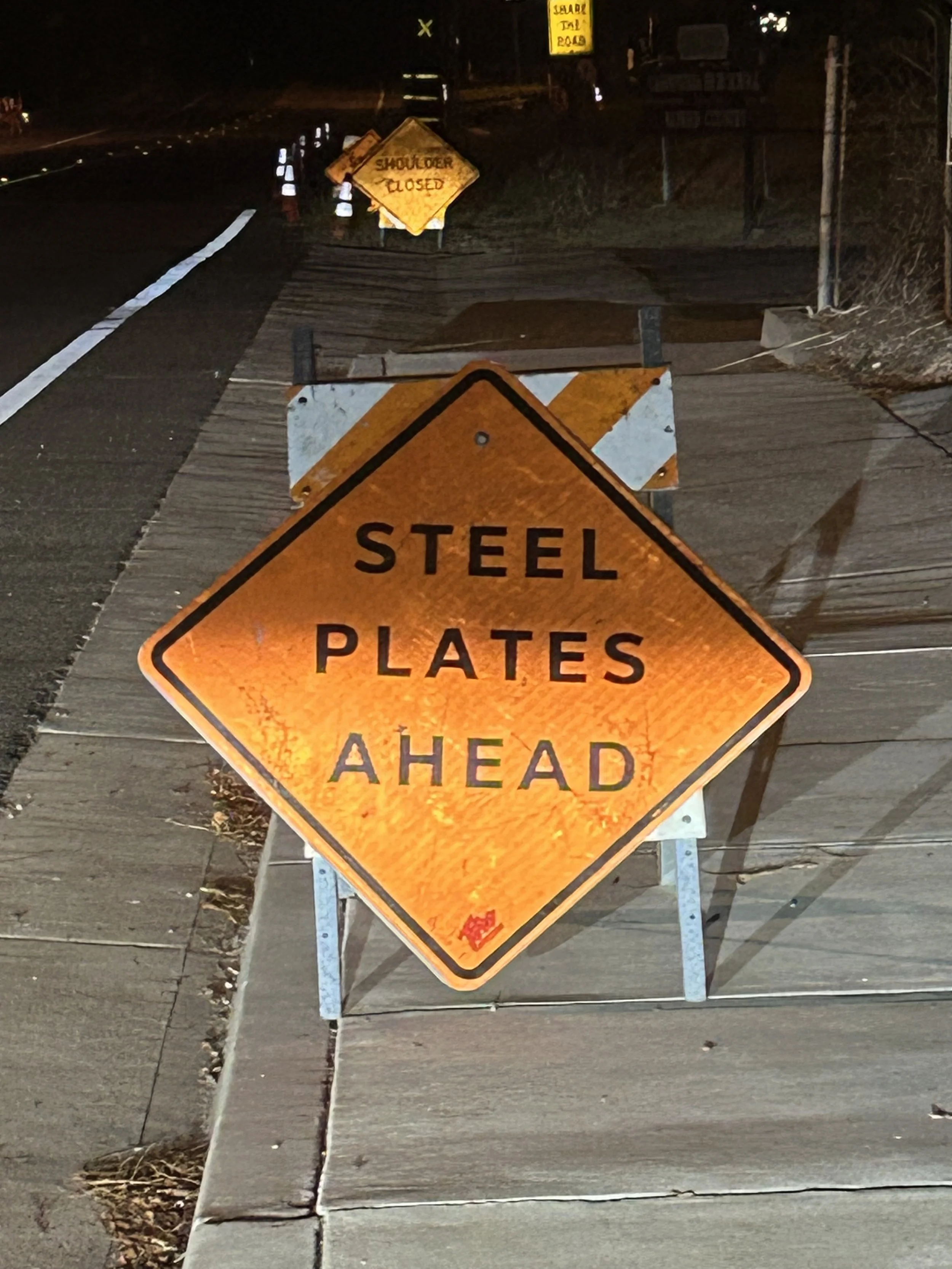
I ran an errand tonight before posting this. I’ve passed this sign many times over a couple weeks, but it made me laugh tonight + proved to be the perfect opening image here!
This post is the post I wish I had found floating in the interwebs awaiting me when I needed it in June of 2025.
It’s about my journey healing from a Lisfranc fracture, and I hope to help at least one person who is recovering from a severe foot fracture.
It might help others too. I don’t know if you have noticed but in the last six months the amount of content on social media asking us to pay attention to foot health, vitality and power has wildly increased. It turns out having your foot be as healthy, strong and agile as possible is a good thing for everyone.
So maybe even the fairly-healthy-footed will find something helpful here!
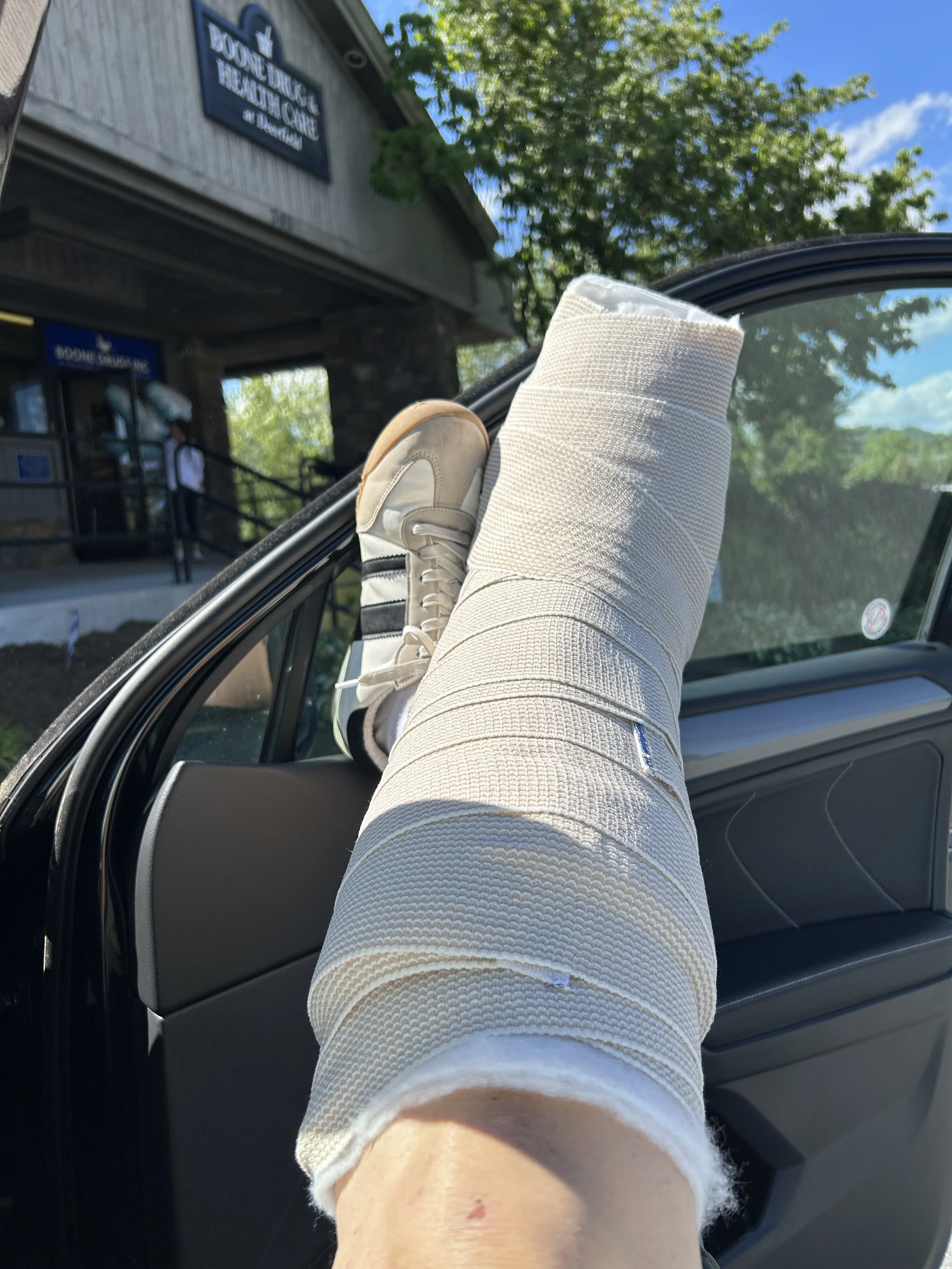
Having just left the ER…
On May 21, 2025, I was at one of my most favorite-very-special-and-meaningful places on earth and had a bouquet of flowers in each hand. I was tripping down some stairs with a smile on my face… tripping being the key word.
I missed a tiny stair and ended up on my back with both feet in the air like a dead bug, screaming very loudly to the several friends in the vicinity “Broken foot! Broken foot!” Two of them happened to be doctors, but their doctorliness wasn’t necessary to know my left foot had been severely injured.
In the ER, I was told that this was a distinct and very serious break – a “Lisfranc fracture” – and the worst one they had seen at that. What wasn’t shattered was dislocated. I was going to need to fly back to LA to get the two required surgeries – the first to pin it in place to allow the swelling to go down, and the second to reconstruct it. Apparently, Lisfranc fractures always require two surgeries.
I only just now – in writing this – looked up who Lisfranc was!
Jacques Lisfranc was a 19th-century French surgeon and gynecologist who served in Napoleon's army. He is best known for discovering and amputating at the midfoot joint. Today, this area of the foot is called the Lisfranc joint, and injuries to this complex are known as Lisfranc injuries.
You do not have to be in a war to get a Lisfranc injury.
Today, doctors usually see these injuries from:
· Sports: Tripping over foot while running or playing soccer.
· Car crashes: The foot gets crushed by a heavy pedal or dashboard.
· Everyday slips: Falling off a ladder or even missing a stair.
It’s true! You don’t have to be in a war, you can just miss a stair! And, praise Jesus, you don’t have to have your foot amputated after you do! Ha!
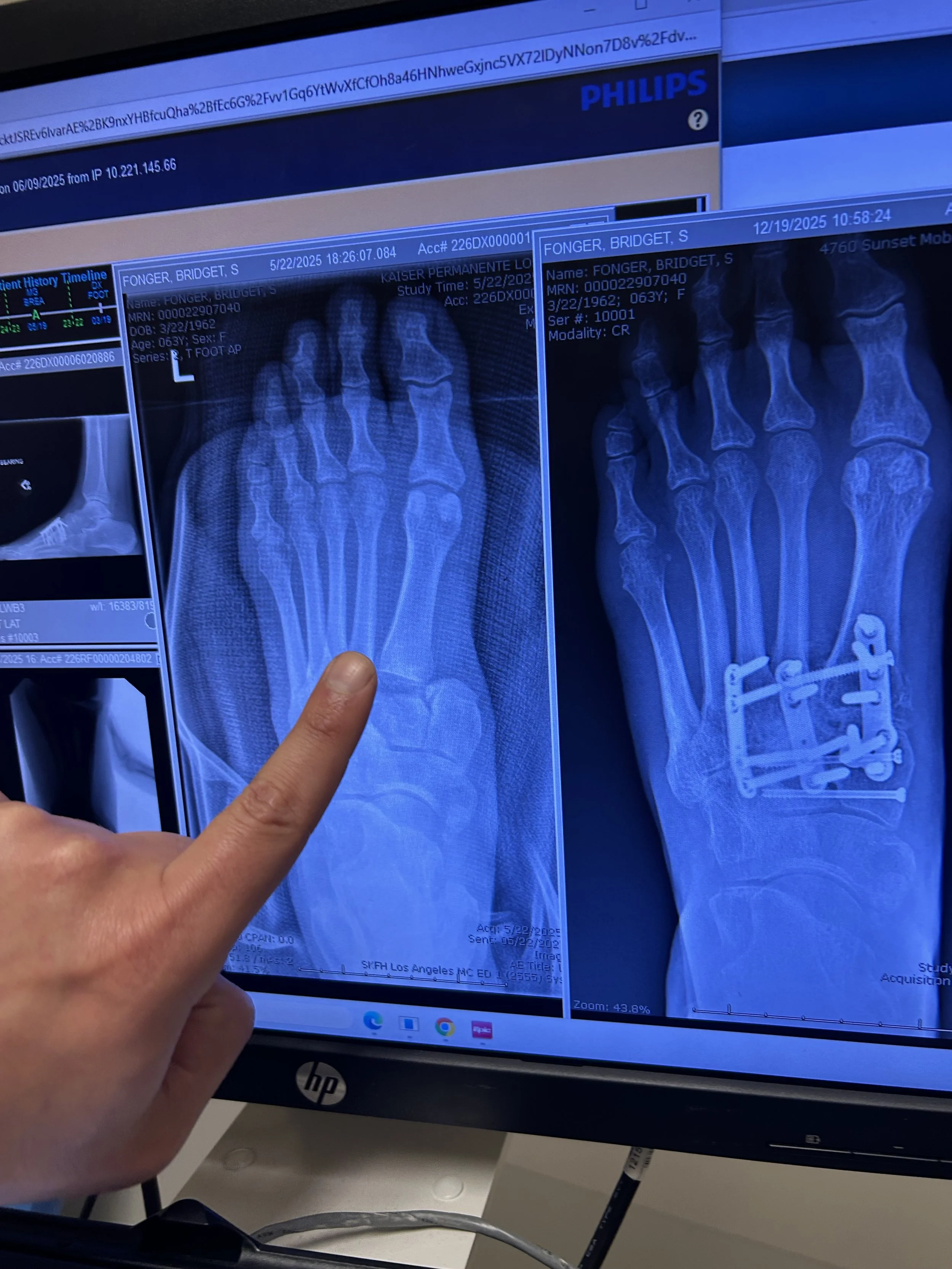
The surgeon explaining the source of the pain…
I was told from the very beginning that my foot would never be 100% and this was going to be a long haul: likely two years to see the level of ultimate healing.
I thought “Oh come on…really? Two years?!”
I had lost my house in the Eaton fire just four months prior to my injury and was told “at least two years” to have the house rebuilt too.
Das Fire and Das Foot: teaming up to create an epic rebuilding saga.
It took 18 months to just break ground with the new house - in spite of my intentions to be moved in within two years. It will be closer to 2.5 years.
I just passed the 14-month anniversary of my second Lisfranc surgery (15 months since the injury), and I’m remembering my intentions to be running with ease at 12 months.
God laughs.
Slow down, “get-er-done girl”, slow down. You’ve got things to learn here.
Of course, I had to slow down for months when in casts and boots. Also, pain has its inimitable way of wrestling you into submission.
I’m still healing every single day and it’s a four steps forward-three steps back process, but I’ve been doing remarkably well all along the way due to my truly great luck + blessed life.
Yes, in spite of Das Foot and Das Fire.
Blessed because every step of the way I came in contact with people who would lead me to a healing source of some kind that I was either ready for at that exact moment or could set on my future healing agenda.
I still beat myself up all the time:
Why didn’t I start THAT sooner?
Why didn’t I call THAT person at the beginning of my journey?
But truly everything was perfectly timed.
Still, I’m sharing it all here because I wish I had found something like this at the beginning of my journey from someone who had been on this “Linfrancian” - or a similar - healing road.
All Lisfranc journeys are a little different.
Mine: Three plates + sixteen screws.
There are 26 bones, 29 muscles, 33 joints, 100 ligaments, 200,000 nerve endings in a foot.
A Lisfranc fracture can have impact on all of them. And there’s very little circulation in our feet, which thwarts healing. So we all need all the help we can get!
Again, hope this helps at least one person.
Lisfranc Specific: Between Two Surgeries
You will make it. Those who came before you all made it to that second surgery. You will too - even though it feels like the worst waiting game on earth. You’ve got this.
Post Surgery Needs
Pain Meds — Before this injury I can count the times on both hands that I used Advil or Tylenol in my life. Even other big injuries. But this is somethin’ else. Take care of yourself by finding what works for your body.
Doctors, nurses and friends will likely chant this to you, but do it: Stay ahead of the pain. If you don’t it’s hard to get on top of it, and your body can’t rest, so you can’t heal.
For the second surgery they gave me a pain blocker above my knee before surgery and it wore off pretty much as I woke up. I always had a very high pain tolerance (had a dislocated (6” out) elbow for 10.5 hours once) but this was different. It made pain management tricky for me.
I found out I cannot tolerate opioids of any kind, except morphine drips. You can’t go home with a morphine drip. I went home with an overly aggressive prescription for morphine pills. That was a nightmare for which I will spare you the details.
Tramedol is a synthetic opioid and – for me – in very small doses, it took the spikiest/knif-iest edge off the pain. Sadly, I didn’t know about it until several weeks after my second surgery. Again, I’m not a doctor, and I know nothing about meds, but I keep running into people like me who are opioid intolerant with high pain and wanted to share my experience with the one thing that took the edge off my pain that I could tolerate. Advil and Tylenol, etc. did pretty much nothing for my pain the entire journey. Hopefully, they will be ALL you will need on yours.
Showering - I just recently saw in the pharmacy that they sell plastic sleeves you can put over your cast. I used — and reused — one trash bag with ties. Same concept, super cheap. I put a wash cloth just under the ties to make sure no water accidentally rolled down my leg and into the cast. It never did.
I also took baths. That’s complicated, mostly for balance reasons. I accidentally slipped off my towel on the edge of the tub as I got out and fell like a wet seal on the tile and slammed my cast into the pedestal sink.
Yes, I too wish I could insert a video of that unbelievably excruciating event here so you could feel superior. Just commit to yourself now that you will not follow in my footsteps. Pun intended.
Medical Equipment
I am lucky to live in a city that has a nonprofit that lends equipment. So, I didn’t have to buy everything. Some things I found used versions of or I borrowed. I needed everything that could make my life less stressful because 1) I’m a klutz, 2) Pain is stressful enough, 3) you have to get used to moving your body with that giant weight on one foot. Things I borrowed or bought:
Crutches – First a confession from this klutz. I wiped out really badly on crutches twice before I even had my first surgery . So, while they were given to me at the ER, I rarely used them because they caused ME more injury. If you are a pro with them, I bow to you.
Knee Scooter– There are various versions of these. I recommend you try them out. See what works for you and your specific abilities to balance. One nearly killed me. Another was my friend.
Shower Chair – I recommend — at the beginning at least — getting one with a back on it. Your balance is wacked out having a new heavy thing on one foot. Any extra support is welcomed by your whole body. You don’t want to sprain or strain other muscles because you are trying to maneuver around. The goal is pain reduction!
Wheelchair– You can’t carry a cup of tea or move laundry around with a device – even scooters with baskets. So, I used a wheelchair a lot the first few months. I couldn’t wait to get it out of my house though, so I let it go a little prematurely. It’s an anti-stressor for some otherwise stressful tasks.
Cane – I only used a cane while I was in my boot for balance – and largely for uneven ground. You realize how uneven sidewalks and driveways are in this world when compromised. Again, I’m a klutz so it served me well.
Toilet Seat Riser – I had good upper body strength and hip strength when I was injured, so I didn’t end up using this. When you are in the hospital for surgery, they will have one in your bathroom. Maybe before you leave, test whether you even need it. At the very beginning I used my walker to help get my bearings.
Pillows – You need to have your foot up for quite a long while. A full body pillow helped me at various points. And someone gave me a pillow that was made to support a neck. I could nestle my cast into it to give it some lift. I suggest you try out scrunching a pillow into different shapes that work for you, and then find a pillow made in that shape.
Walker– You will leave the hospital with one. Nothing complicated here. But I had two because my rental is on the second floor so one was upstairs and one was downstairs to get me to my car and beyond.
Yes, I drove. It’s my left foot and I could have my left foot perched next to my rearview mirror. Apparently not so legal so I don’t recommend it, but I was 90 minutes away from my surgeon, so I didn’t have a choice.
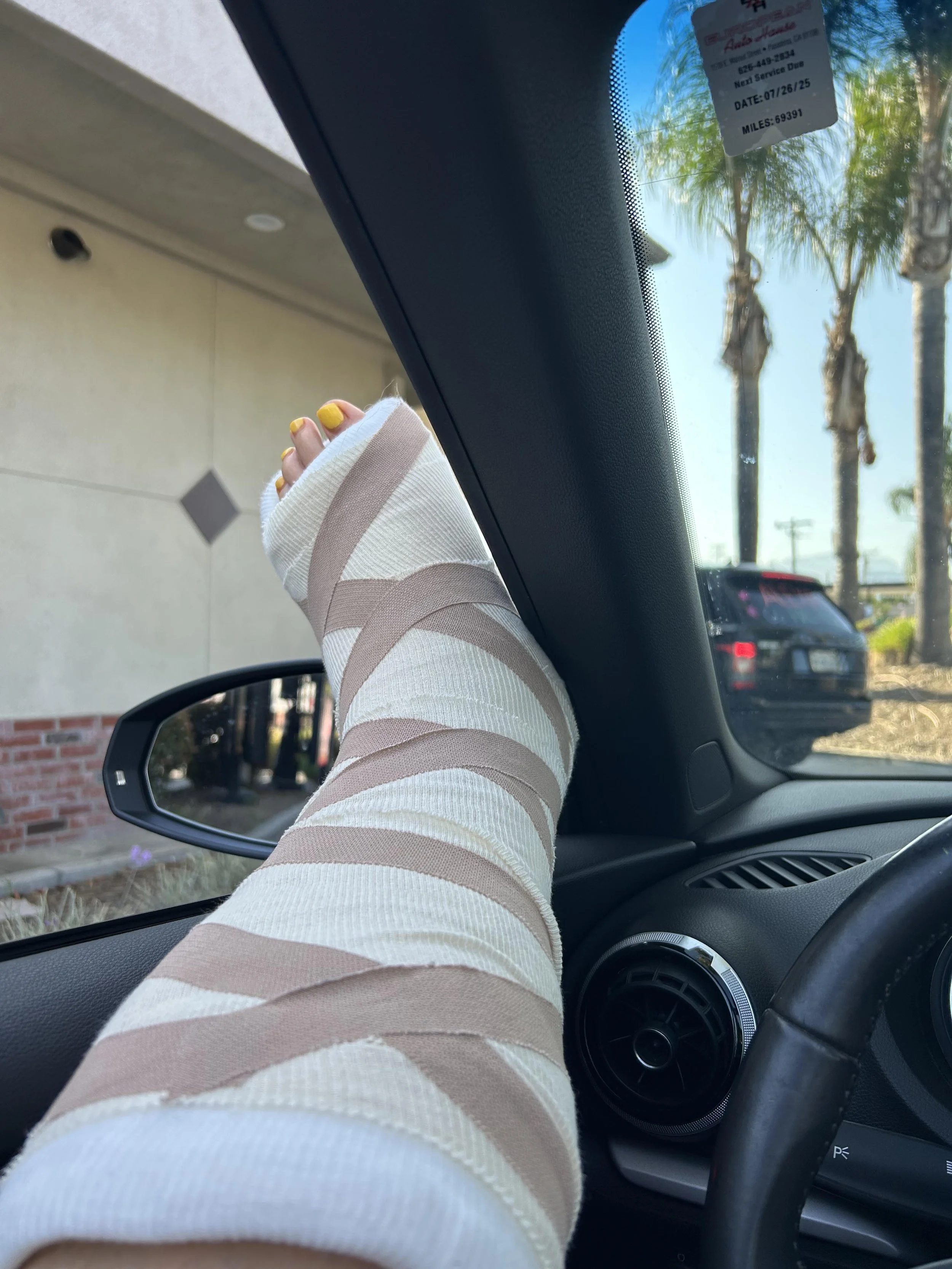
Speaking of driving…
Temporary Handicapped Parking Placard – Have the doctor do the paperwork for you right away so you are good to go. I took my form to the AAA and got it super-fast. You do not want to be schlepping through parking lots with a walker.
Speaking of shopping…
Shopping Scooters – Don’t be embarrassed to use them. They rock! And they are so fun and efficient. At Trader Joe’s the people are so great about helping bring them to and from your car.
Post Casts + Boots
Physical Therapy — I start with this topic because while I wasn’t in PT long, many people avoid it due to not having time or having had a bad experience in the past. Worse, many surgeons don’t recommend it. My surgeon doesn’t believe in it. He said that the best therapy was just living life. But bones start healing wonky and jutting out in the wrong way, toes don’t land right without some supervision and guidance.
There are so many bones, ligaments, joints and nerves involved here, I recommend you get professional attention from someone who knows every complexity in your foot.
I don’t know of anyone these days – no matter what their insurance coverage – that doesn’t have to wait a long time for a PT appointment. I recommend you ask your surgeon for a referral as early as practical.
And if you don’t like your physical therapist, ask for a different one. I needed one who was behind me getting as close to 100% as possible.
I walked into my first PT appointment at month #5 of my reconstructive surgery (which happened a month after my injury), a whole month after I was out of a boot. She thought she had the wrong person. She stopped abruptly in the hall and said “Wait -- are you the Lisfranc fracture?” She had just looked at my x-ray and hadn’t expected me to be walking without some sort of aid. She was a great ally until I could run with everything she gave me on my own.
Then my Sports Massage Guy who treats competitive athletes and knows every bone, muscle, tendon, etc. came into the picture and gave me far more knowledge and very targeted exercises to get my foot working again - with all those metal pieces moving with as much harmony as possible with the flesh and bones.
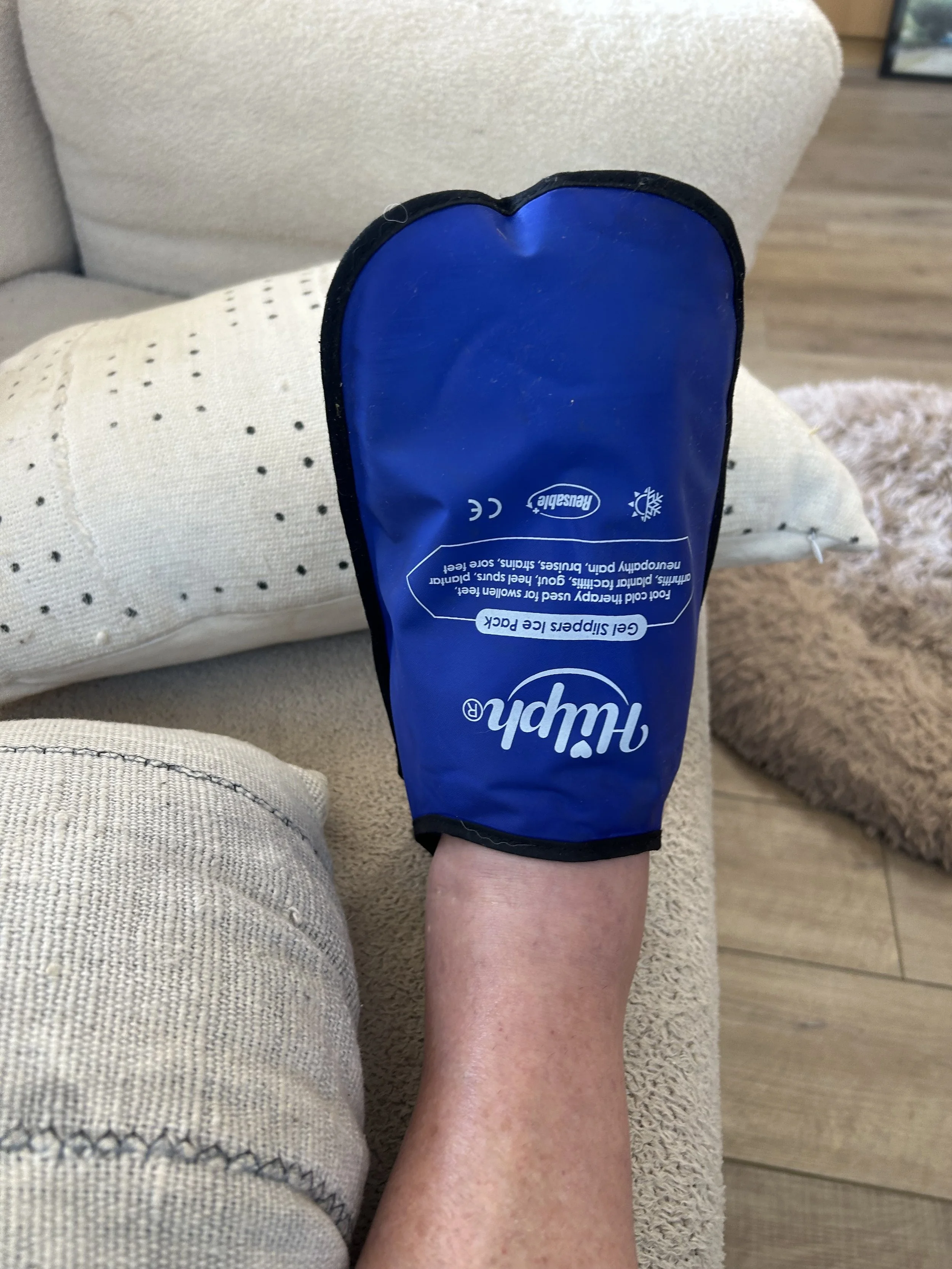
Ice – I can’t imagine anyone with a badly broken foot feels anything less than exhilaration at being let out of a boot - to not only shower but ice the hell out of that thing. Had I not been in a small rental, I would have bought a “cold therapy machine.” So, I would highly recommend that if you have even a several week road ahead of you where ice will be needed. Instead, I bought a bunch of ice packs that I could wrap around my foot. But because of toe dislocation and still-painful-and-overly-sensitive top of my foot, this was my favorite thing on earth for about three months. Bonus: they come as a pair which means you always have one cooling in the freezer: Ice Slippers (more on ice later)
Resistance Bands — The only thing my doctor wanted to do was stretch with the resistance bands. I did it as much as I could, but at least 40 minutes a day. Super helpful for calf stretching and also for starting to get my toes back on line after being dislocated for so long.
Feldenkreis – I had only heard of it but never practiced it. Soon after I got out of my cast, I started doing it. After months of hopping, endless pain -- and therefore “hanging on for dear life” by most of my muscles – this let my body relax back into its nature, brought my body back to earth, worked miracles with my nervous system (beaten down by Das Fire and Das Foot) and has me standing far more sure-footed.
Balance Exercises – My balance is finally back! I’ve been working on it since I got out of my boot. In the last two months I’ve worked especially hard and it’s paying off. I do it on both legs because your whole body is wacked out by an injury like this. I started out simple and now I do pretty advanced stuff on my yoga block and on my vibration plate on my toes. (See more on balance when I talk about the Vibration Plate below.)
Finally, I don’t mention acupuncture because I didn’t have the bandwidth to add it in. Leaving my house was such an ordeal for months. But I believe in it. Years ago, it solved my severe plantar fasciitis in three sessions and it has been a godsend for many issues over my lifetime. Had the fire not taken my house, I would have absolutely gone to my beloved acupuncturist to support my healing and address my pain as well.
Detox/Circulation/Feel Good
These next two are good for circulation, lymph system, detox, etc. and they make me so happy.
Vibration Plate – I had had a vibration plate before the fire. LifePro Fitness sent me a replacement for free. Lovely company! I started very slowly with it after I got out of the boot. Now I do upper body work, squats, planks and lots of balance work on it. I love stretching my foot by standing on my toes and doing squats while on my toes. You can imagine balancing alone on a vibration plate is a great workout. It’s a godsend post-surgery as it gets the lymph moving and helps detox from all the crap I had ingested for months post-surgery.
The other thing I do is stand on my Squat Wedge Blocks on the vibration plate while I do upper body exercises. Stretching my calves consistently keeps the pain in the ball of my foot at bay. That pain is super common with the Lisfranc and I hear common with other foot injuries after you’ve been in a cast for a long time.
Rebounder – The PT and surgeon weren’t quite sure this was a great idea. But I needed the feeling it gave me. I started with 50 jumps a day. I loved how my foot felt when I went high in the air and could try to point it with freedom and less pain. I went to 100 jumps, then 200, then 500, etc. It took me 10 months to get to jogging because that requires better balance. I have a handle I can grab onto – which I used for very spurts of jogging with feet barely lifting, but I couldn’t quite master – or muster the rhythm of high knee slow jogging until now.
Recently, I broke a sweat while working out for the first time last month. It was bliss. So I’ve been doing it every day since. Luckily, I live alone because it can’t be pretty. It’s a 30-45 minute “jog” on my rebounder, knees high in the air, like a cartoon version of myself running. But I get better and better and it’s more fun each and every time.
I likely could have worked up a sweat with cycling far sooner. But I lost my Peloton in the fire and I don’t have room for one where I am temporarily living.
Finding your bliss in some workout method that does not impact your injury is priceless.
Swimming – As soon as I got my boot I started swimming anytime I was near a pool. It made me feel whole and normal and it was blissfully freeing for my foot after being confined for months. It helped heal my entire body to move and exercise in water.
Massage – My genius “Sports Massage Guy” lives down the street from me in Altadena. His house didn’t burn down, but he’s still displaced due to horridness around his remediation process. I showed him my foot that had an ever-burgeoning protrusion from under one of my steel plates. He urged me to have a session. I should have been going to him as soon as my boot was off! Huge jump in healing due to his deep knowledge of foot structure and exactly what it needed to stop the damage. Find people who know feet. Not every sports massage person does. His work on my foot has catapulted me to a new level of total-foot-healing.
Walking on Sand – One of the miracles of Das Fire is I now live six minutes from a beach where my dog can be off leash (I couldn’t walk her on leash for a very long time with this injury, of course) and I can walk barefoot in the sand, making my foot turn and move more like a normal foot in spite of the metal. I had to slowly increase the length of these walks, but now I can walk an hour or more. I still need an ice bath afterwards, but it’s delicious movement – sometimes painful – but overall feel-good movement that makes me feel remarkably free! I can pretend I have a normal foot. I had to run on the sand recently and I paid for it for a couple days. One day though…one day!
Foot Support
Toe Socks– This may be unique to me since my toes were dislocated. Toe socks helped me get them better aligned. I had to work up to using them for extended periods. Once I did, they started making a market difference. I got mine at Happy Feet.
Shoe Inserts/Arch Support– The secondary pain (not near plates, screws) I experienced was in the ball of my foot. This pain is due in part needing to stretch your calf muscles – and other muscles -- after having been in a cast for a long time. But you also need arch support. I also got slip-on shoes with arch support. My feet don’t fit in normal shoes still so these are my fave mode of transport still.
Velcro — I happened to have had Ugg sandals pre-injury with velcro closures. They have padding under the straps which makes them have the softest touch on the tissue around screws/plates. Soft is hard to find. And velcro allows for constantly expanding and contracting foot. I bought Commbi shoes a couple months ago because they were a nicer looking version of slides, and have velcro closures. At that point, the top of my foot was too delicate for them. They were not soft enough. Now, they are perfect. The arch support is divine.
Salves/Balms/Healing Elixirs
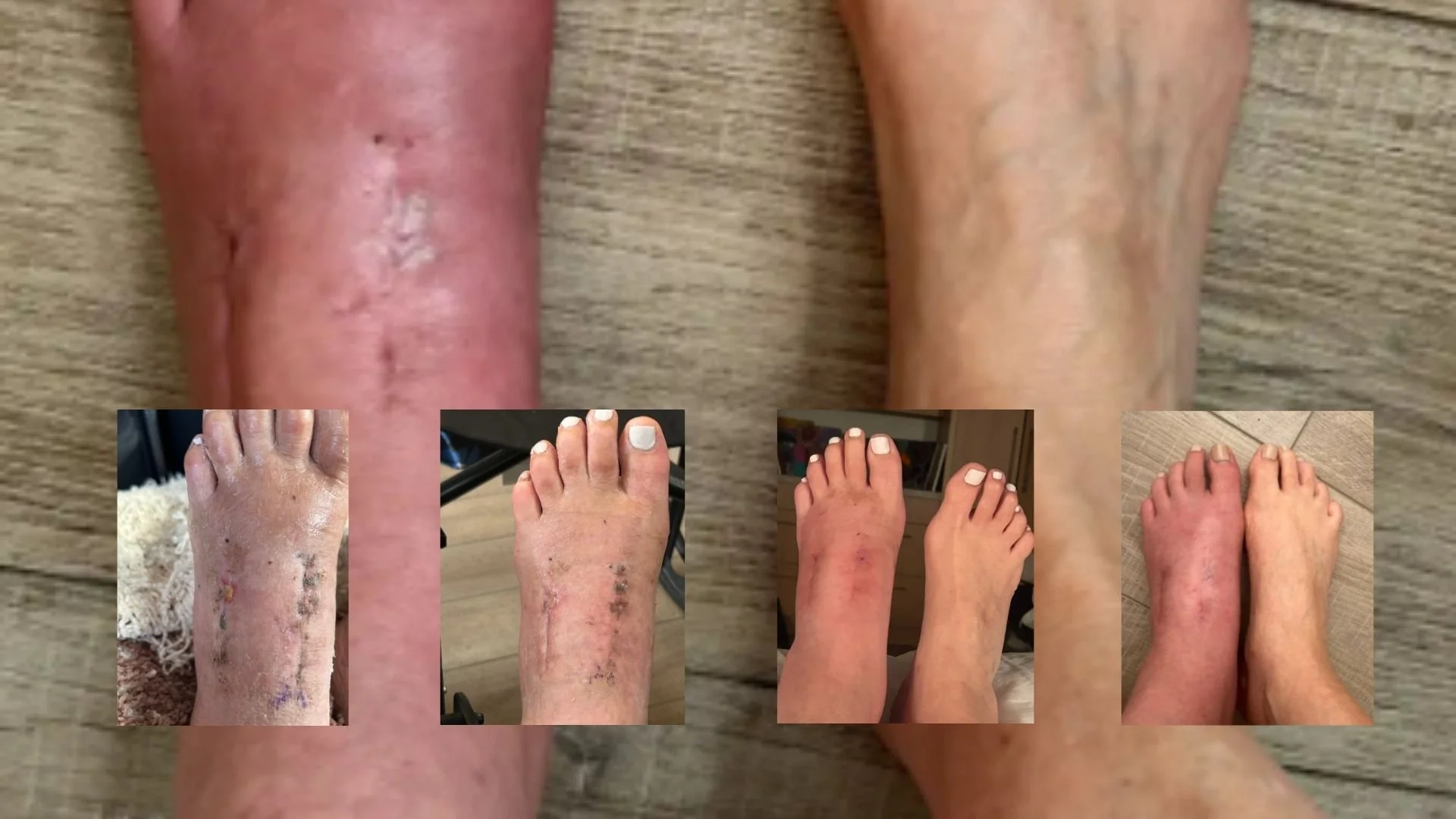
Comfrey Salve – Someone suggested this to aid bone healing. It felt good. Comfrey has been used to knit broken bones for generations.
Castor Oil – There was a pocket of inflammation in one area of my foot, and I had been trying to remember what oil or salve I had used in the past for inflammation. Had my dad been alive he would have reminded me. I finally remembered I used Castor Oil packs on my lungs to shorten a bout of pneumonia’s duration once. Within three nights that pocket of inflammation disappeared. I used it on my foot most nights for months.
Emu Oil –It was suggested by my Sports Massage Guy for my scars, which I hadn’t really been caring about as the doctors and nurses seemed impressed already by their healing, so I thought I was doing OK. But – this -- Emu Oil is a wee bit o’ magic, not only because it penetrates the surface layers of the skin to deeply heal scars BUT it also carries with it anything you put on top of it, which brings me to…
Ibuprofen Gel– Again from my Sports Massage Guy. We don’t have in the U.S. He had it from competing in England, where it is readily available – even at Boots! The magic for me was putting the ibuprofen gel on top of emu oil. Traumeel also helped. In the past I’ve used Arnica Gel, which helped a lot, but it didn’t help me with this injury. It may be for you!
Therapeutic Tools
Bemer – I’m a huge fan of Bemer mats for healing and have had one since 2016 but they work with electromagnetic pulsing. Magnets cause the plates and screws to move – almost imperceptibly but you can feel it and it was too disconcerting for me so I dropped it for this injury.
AlphaStim – This came recommended by a doctor and he had to order it for me. It did alleviate pain signals, and I used it for about a month when my pain was super acute – the first month out of the boot. BUT when the swelling went down the electric current bouncing around more with the metal implants made it no longer a happy experience. Check it out, though, if you have high pain and ask your doctor about it if you are considering.
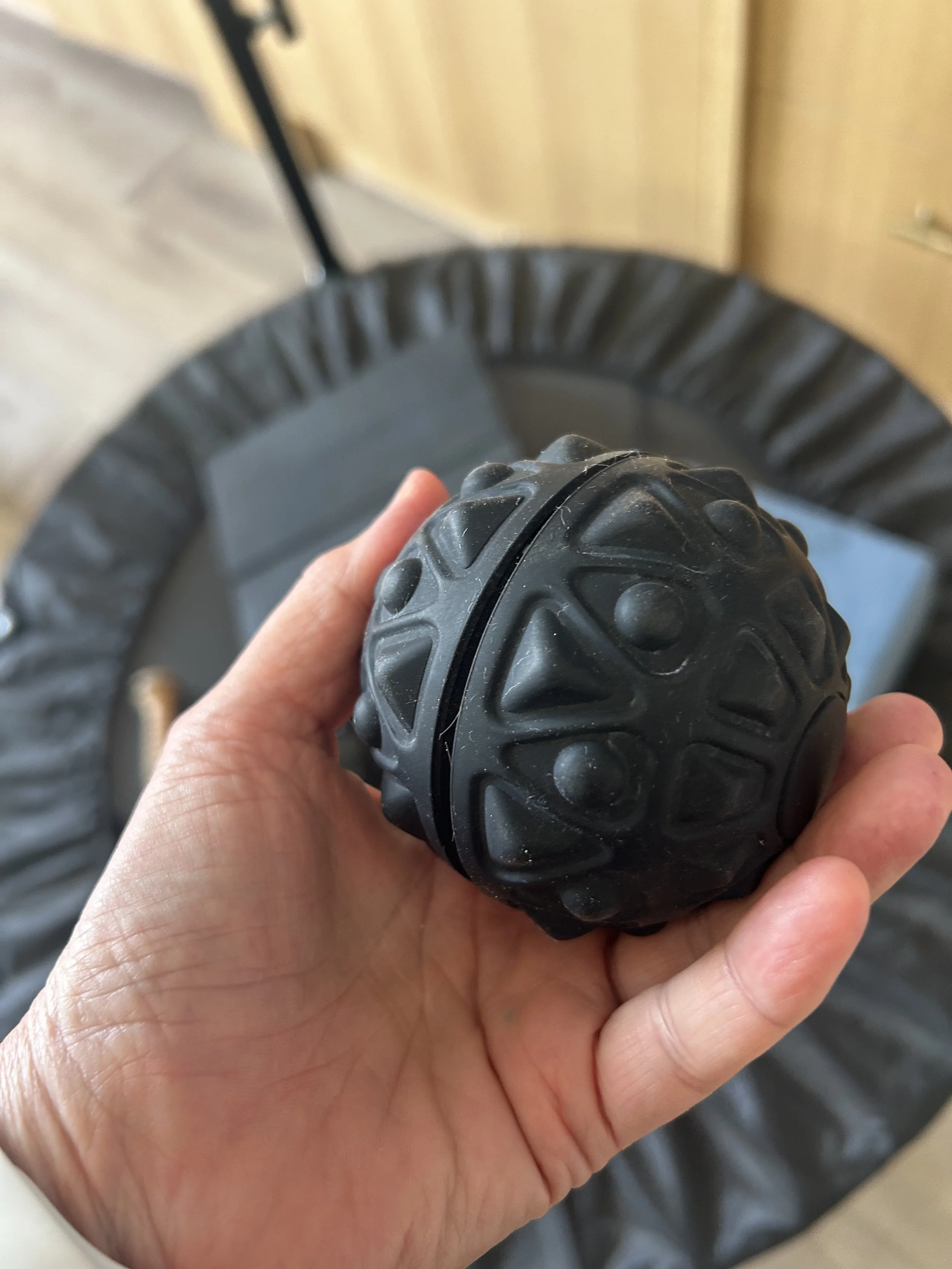
Vibrating Ball – Several months in, I knew my foot needed massage. I had two of these LifePro Vibrating Massage Balls that I had gotten for free when I bought my vibration plate and rebounder from LifePro. I decided to try it – hesitatingly because there is nothing more unnerving that vibrating metal inside your foot. It felt good in small doses at first and now I use it religiously along with…
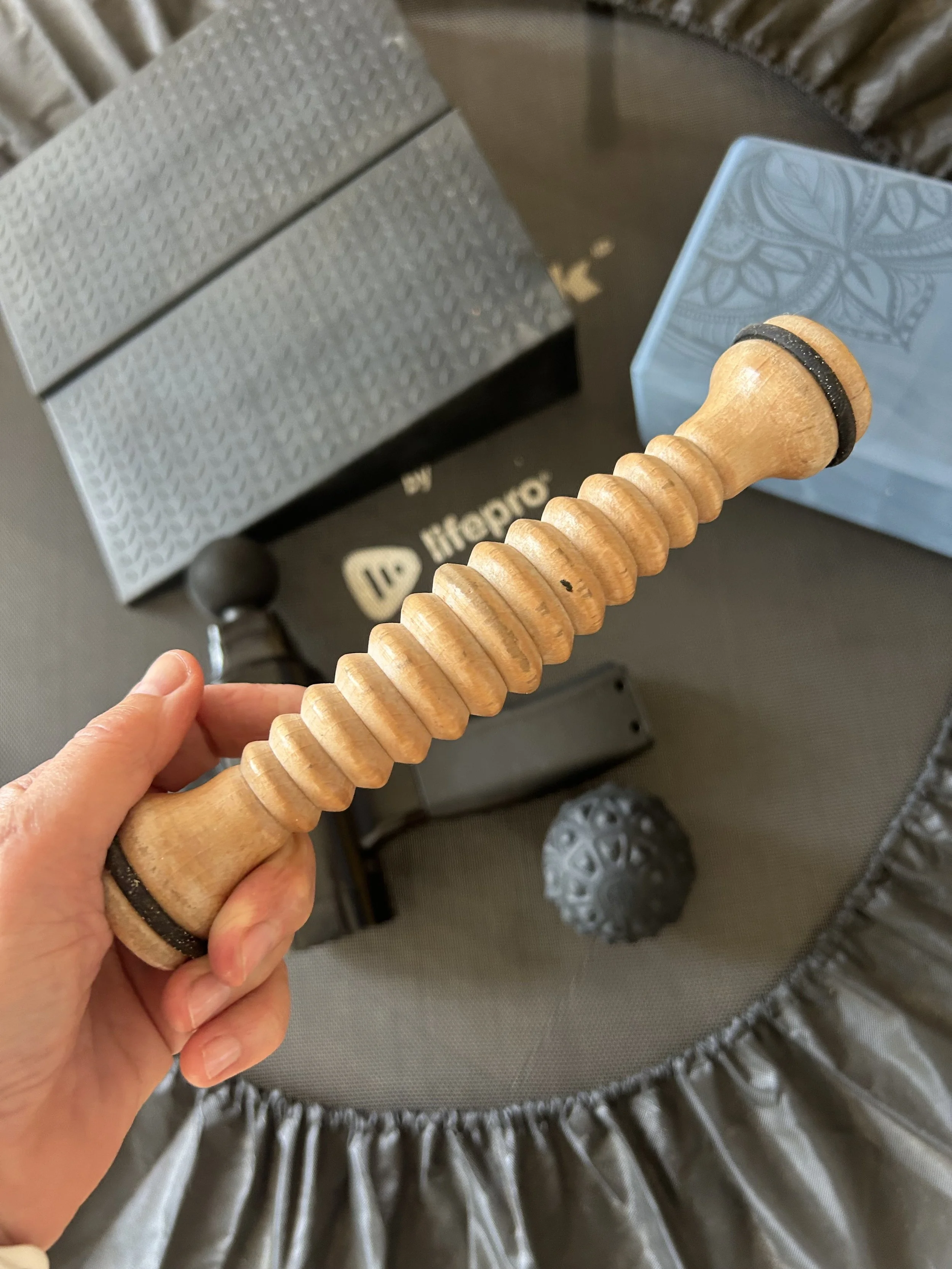
Roller – My amazing Sports Massage Guy recommended this. It feels seriously divine — after it feels seriously painful. Then it feels mostly just great every time you use it. I didn’t start this until Month #10. Not sure if it would have felt divine sooner and/or if I missed out on some potential healing had I been using it!
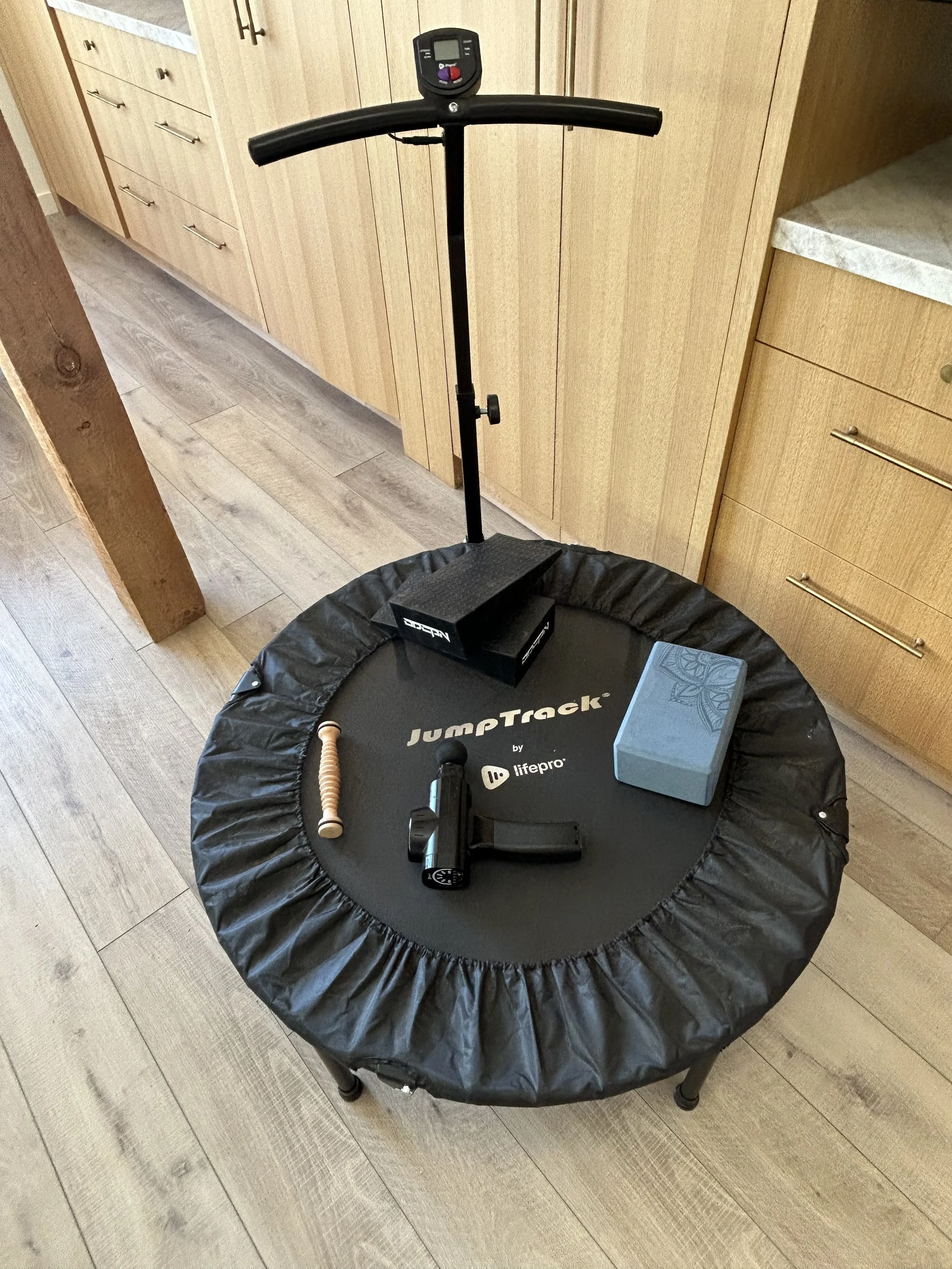
Massage Gun -- I tried using this too soon at one point and it felt like it made the steel and screws rattle. But I could have come back to it sooner than the year mark. It really helps loosen up the muscles under my foot, the arch particularly, to start working like normal. My Amazing Sports Massage Guy also recommended this. It feels seriously divine. This I didn’t start until Month #10. Not sure if it would have felt divine sooner and/or if I missed out on some potential healing had I been using it. If you have the pain in the ball of your foot, use it on your arch to ease that pain.
Ice Man Re-Cometh – Month #11 the Amazing Sports Massage Guy told me I should be working on my circulation with alternating hot water foot bath and ice water foot bath. Repeat. Some days when I am on my feet longer or work out harder, I do just ice to calm it down. But I accidentally dropped ice baths for a while because I was just burned out in the first few months with the boot off of having my foot cold all the time. It was the best thing for pain relief. Again, had I had space I would have gotten the ice machine mentioned above. I still have to ice my foot after workouts, beach walks and/or if I’ve been standing for a long time or maybe cooking for a few hours straight. The pain is no longer vicious in nature, but an ice bath takes away what pain there is and reduce the swelling that comes with every push toward healing.
Heart, Spirit + Soul Intervention
You can pretend that a physical injury is only an injury to your body. But, the sooner you understand that an injury inflicting this much pain is affecting body, mind, spirit, soul, the better off you will be.
Any injury has a traumatic component, but having to wait for the surgery that puts Humpty Dumpty back together again is hugely traumatic. I had to wait for the Lisfranc specialist an extra two weeks. Most people only wait two weeks — but my god, two weeks is already traumatic. I bow to all of us who wait with our shattered feet.
I was more acutely aware of the trauma angle because I was only 4 months away from my fire trauma. But having more than one trauma at a time is no longer unique. The world is so intense!
You have to take care of your heart along the way.
Protect Your Heart — I’ve had to learn some heavy duty lessons around boundaries. I have to say “no” or “not yet” a lot.
I have had to shield myself from negativity. I have friends who like to talk about current events, news, politics. I couldn’t do any of that. Literally had zero tolerance for it.
And my greatest joy, offering to help others carry their hearts — I couldn’t do it. This has been one of the hardest parts of my journey. I have beloveds who have lost their beloveds who I couldn’t support through their losses.
I kept dropping my own heart. I had no ability to help others carry theirs.
Therapy — I started therapy for the first time in 20 years. Honestly just having a non-friend say “that’s a lot” meant the world to me. She gave me as much support as she could. I had to do the heavy lifting but having a professional in my court meant the world.
Transcendental Meditation (TM) — Only a few weeks after surgery I was initiated. My classmates will tell you they heard me coming to class. Ca-lump, ca-lump, ca-lump, hopping with my walker. It helped me with the trauma chatter in my brain.
Healers — A mere three weeks after surgery (yes, in a cast and in pretty extreme pain) I had a session with a healer who came highly recommended for bone injuries in particular. I wrangled myself onto his table and the second he put a hand on me I burst into tears, and a lot of that trauma came flowing out. I felt a shift inside my cast, like a release that allowed my foot to actually move in a new way. I had a leap in healing after that.
At the 13-month marker, I had a session with a healer that was pretty breathtaking. I had a lot of anger at myself for falling, anger about the fire, anger at all the little traumas over 18 months. That anger and more trauma and sadness flowed out during the session and in following days. My foot visibly looked different the day after that healing. It marked another huge leap in healing.
Speaking of healers…
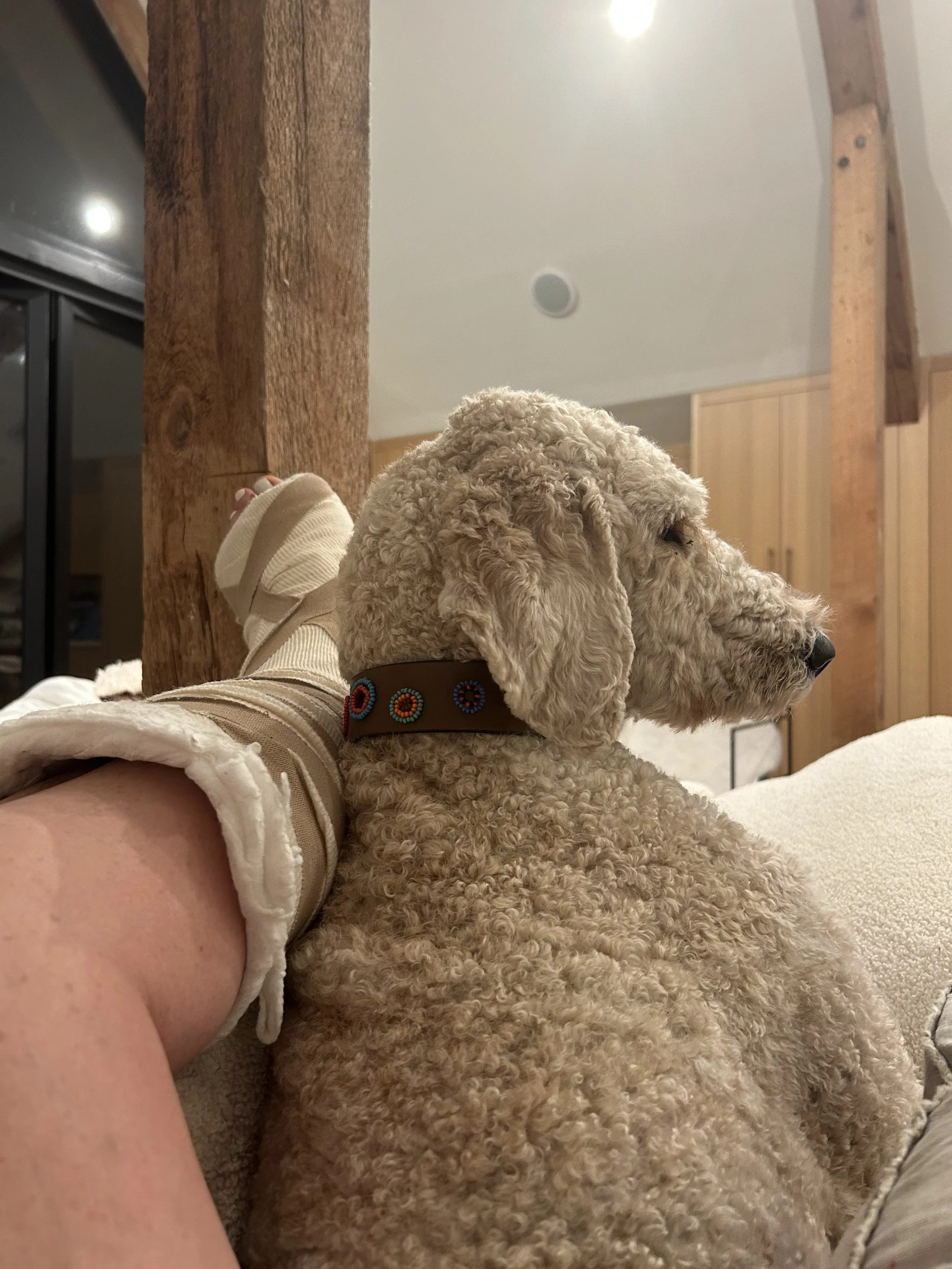
Stella - Get yourself a funny furry healer who will stand by you even when you can’t properly attend to them, who isn’t mad when you wipe out and fall on top of them, and pretends she’s cool with not being able to be walked or played with as much as before Das Foot.
And…who…celebrates the healing. This is Stella and my foot on the day I’m posting this.
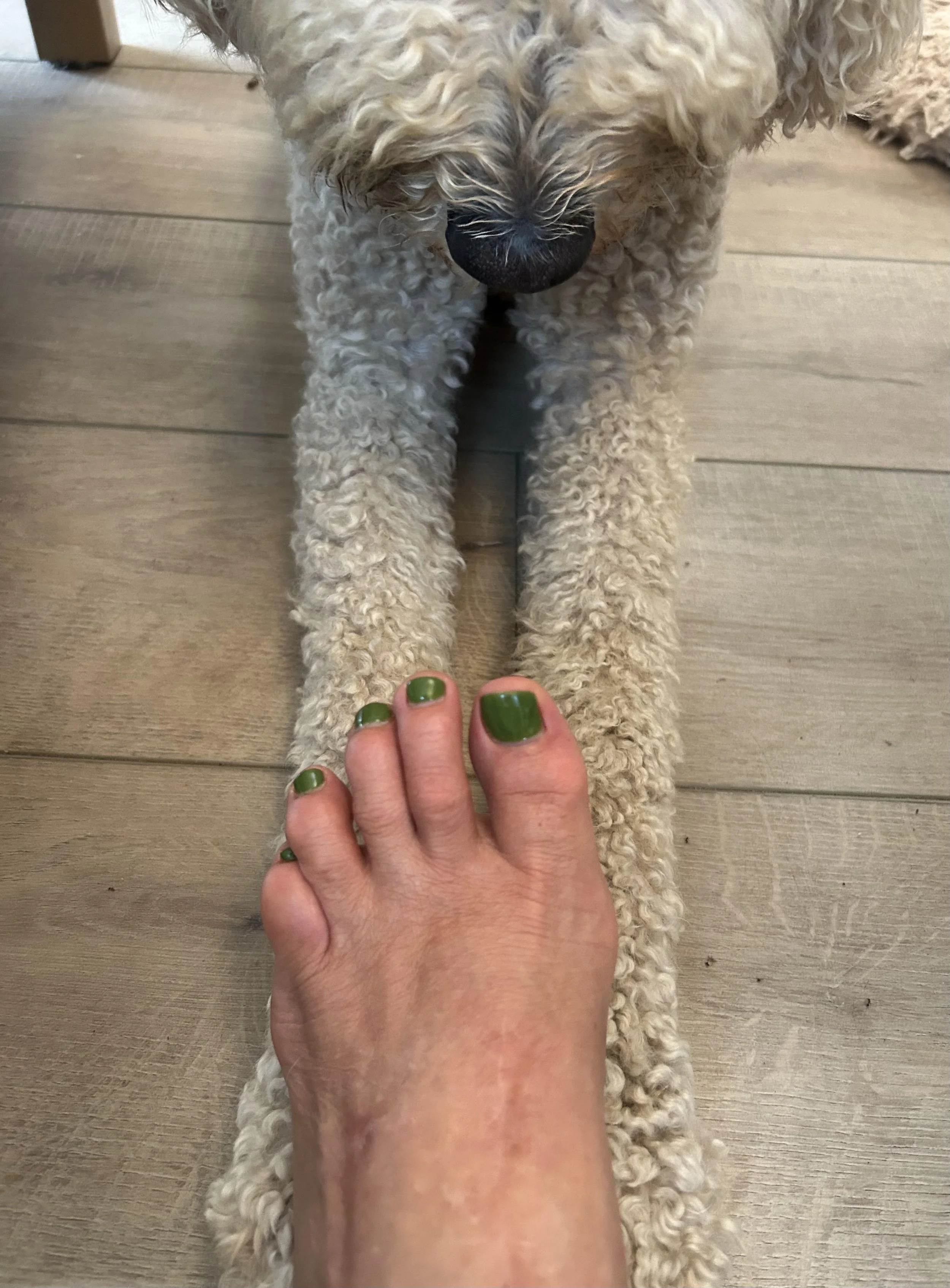
My foot looking relatively normal is a result of everything mentioned in this post…plus divine interventions of various sorts!
If you are dealing with a Lisfranc fracture and you just want to vent – or you have any questions, feel free to email me – bridget@superherooflove.com.
May your “Das Foot” Lisfrancian — or other foot break recovery — journey be even smoother and far more graceful than mine!
